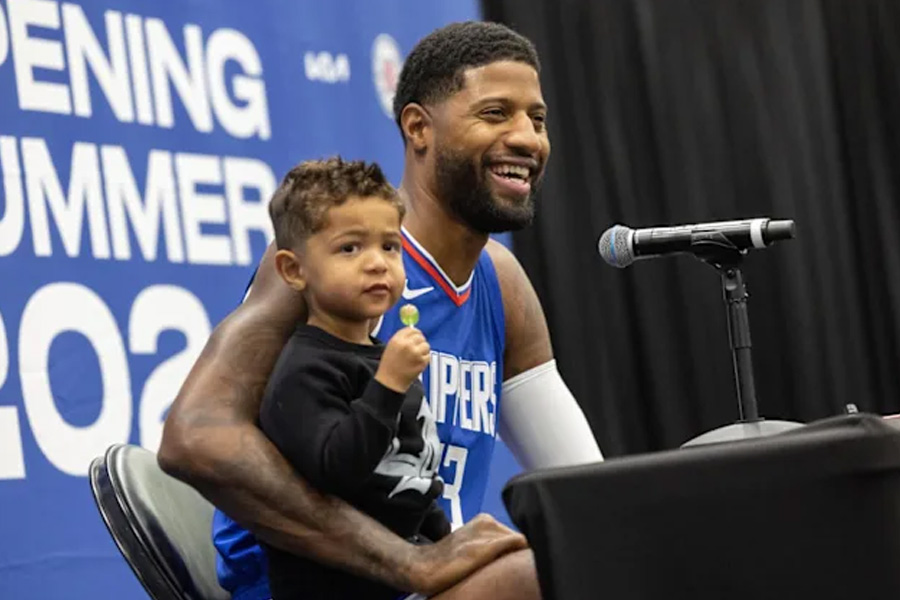

A childhood lived in the glow of cameras and the hush of home
I find Paul Vuk George interesting because his story is not just about being the child of a famous athlete. It is about growing up inside a family where fame, culture, and privacy have to share the same small room. That is a delicate balance. One moment, the world sees polished photos, courtside moments, and luxury travel. The next moment, the real life is much simpler: breakfast, sibling chatter, bedtime routines, and the ordinary magic that keeps a family steady.
What makes Paul Vuk George stand out is the contrast. His life is tied to a public figure, but he is still a child first. That distinction matters. It means the headlines may orbit around his father, but his own identity is being shaped at home, in the quiet spaces where children learn language, habits, and trust. When I look at a child like this, I do not see a miniature celebrity. I see a young person at the center of a moving constellation, with every family member acting like a star pulling gently on the same orbit.
The meaning carried inside a name
Names can be small houses for big meanings, and Paul Vuk George has one of those names. The first part connects him to his father, which gives the name a clear family line. The second part adds texture. Vuk is a name that carries cultural weight, strength, and a sense of older roots. It sounds sharp and memorable, like a bell struck once in a quiet room.
I like that kind of naming. It tells me a family is not just passing along an identity, but building one. That matters for a child who may be seen in public before he can explain himself in his own words. A name can become a first story. It can point to heritage, family pride, and a wish to keep something meaningful alive across generations.
Paul Vuk George also sits at the intersection of different worlds. He belongs to an American sports family, but the cultural threads around him stretch farther than one country or one career. That blend can give a child a richer sense of belonging. It is like being handed more than one key to the same house.
Growing up with a father whose career is always in motion
A child of a professional athlete often lives with a calendar that never fully stands still. Seasons begin and end. Teams change. Cities shift. Training, travel, recovery, and obligations shape the rhythm of the year. For Paul Vuk George, that means family life probably moves to a tempo most children never hear.
I see that as both a challenge and a gift. The challenge is obvious. It can be hard for any child to build routines when adults are constantly balancing work with travel and public attention. The gift is that a child also gets a front row seat to discipline, persistence, and performance under pressure. Those are not abstract ideas in a home like this. They are lived habits.
There is also something powerful about seeing a parent build a career in the public eye while still trying to remain present at home. That kind of example can shape how a child understands effort. Success is no longer just about applause. It becomes about showing up again and again, even when the spotlight fades.
A household shaped by siblings, not just headlines
Paul Vuk George is part of a larger sibling circle, and that changes everything. Siblings are the weather system of childhood. They can bring storms, laughter, competition, loyalty, and inside jokes that outlast the moment that created them. In a family with older sisters, the youngest child often learns by watching first and speaking later.
I imagine that dynamic giving Paul Vuk George a strong sense of rhythm. Older siblings often act as translators for the world. They model how to move through a room, how to claim space, and how to bounce back after a bad mood or a small disappointment. They also create a built in audience, which can turn a living room into a tiny theater and a backyard into a full stadium.
That kind of environment can be grounding. Fame may swirl around the family, but sibling life is still sibling life. Someone wants the toy. Someone wants the attention. Someone knows exactly how to make everyone laugh. In homes like that, the family story becomes larger than any single public image.
Privacy as a kind of family treasure
One thing I keep coming back to is privacy. For families linked to public figures, privacy is not a luxury. It is a boundary, a form of protection, and sometimes a kind of love. Paul Vuk George appears in public moments, but those glimpses do not define the whole child. They are only the bright edges of a much bigger picture.
I respect families that try to keep a child’s life from being fully exposed. Children need space to become themselves without the weight of constant interpretation. They need room to be awkward, playful, frustrated, curious, and unfinished. Those are not side notes. They are the foundation.
In a family like this, privacy can act like shade on a hot day. It does not stop growth. It helps growth happen safely. That is especially important for a child whose life could easily be turned into a public narrative before he has had a chance to author his own.
The next chapter is still unwritten
What interests me most about Paul Vuk George is not what he has already been seen doing, but what his environment may help shape over time. Children raised around sports often absorb more than athletic habits. They learn how to handle attention, how to read a room, how to stay composed, and how to navigate change. Even if a child never follows the same path as a parent, that upbringing leaves marks.
I also think about the cultural side of his story. A child raised with family traditions, language threads, and a strong sense of lineage may grow up with a broader map of identity. That map can become especially valuable later in life, when young people begin asking themselves who they are outside the family name.
For now, Paul Vuk George remains a child at the center of a family story that is still unfolding. That is what gives the subject weight. It is unfinished. It is living. It is a house still being built, room by room, with laughter in one corner and history in another.
FAQ
Who is Paul Vuk George?
Paul Vuk George is the son of NBA player Paul George and Daniela Rajic George. His name has drawn attention because it reflects both family continuity and cultural meaning.
Why does the name Vuk matter?
Vuk is a name associated with Serbian heritage and carries a strong symbolic feel. It gives the child’s full name a distinctive identity that connects to family roots.
How many siblings does Paul Vuk George have?
He has two older sisters, which places him in the youngest position in the family. That often shapes how a child learns, plays, and relates to the people around him.
What makes his family story notable?
His family blends professional sports, entrepreneurship, cultural heritage, and public visibility. That mix gives his upbringing a rare combination of pressure and privilege.
Why is public interest in him so strong?
People are often drawn to the families of famous athletes, especially when children appear in public moments. In his case, the interest is amplified by the meaning of his name and the visibility of his father.
What kind of future might he have?
No one can know that yet, and that uncertainty is part of the story. He is still young, so his future is a blank page rather than a finished chapter.


