
A name that lives between notice and privacy
I think Zofia Jade Page is interesting precisely because she is not loud. In a culture that rewards oversharing, she seems to exist in a quieter register, like a song that stays in the background until you realize it has been shaping the whole room. Her name appears in the orbit of Jimmy Page, but the public record around her is thin enough to invite interpretation and solid enough to resist fantasy. That tension gives her story a particular charge.
What stands out to me first is not a dramatic career launch or a constant stream of publicity. It is the shape of the family itself. Zofia belongs to a household where legacy is not an abstract idea. It is a daily inheritance, something inherited like a coat that fits the shoulders but still needs tailoring. Her father is one of rock music’s most recognizable figures, and that fact alone ensures attention. Yet the public image around Zofia remains carefully composed, more like a framed photograph than a live broadcast.
I read that as a kind of modern self-portrait. Not every person born near fame wants to become a performance of fame. Some people prefer to hold the center of their lives away from the stage lights. Zofia Jade Page appears to live there, in the dimmer corners where choice matters more than spectacle.
The Page family as a living map
The Page family is not a simple line, and that is part of what makes it so compelling. It is more like a branching river system, with separate channels that still feed into the same body of water. Jimmy Page’s children span different relationships and different moments in his life, which means the family story stretches across decades rather than one neat era.
Zofia’s mother, Jimena Gómez-Paratcha, is part of that broader family landscape. Her presence matters because it adds another layer to the story, one shaped not only by celebrity but by partnership, movement, and a life lived partly outside the stage. The family also includes Jana, who is widely described as an adopted daughter, and Ashen Josan Page, Zofia’s younger sibling. On the older edge of the family, there is James Patrick Page Jr. On the more visible creative side, there is Scarlet Page, who has built a public identity of her own. And then there is the newer, quieter extension of the family circle, including Scarlett Sabet, who has been publicly linked with Jimmy Page for years.
This matters because family fame is not just about names in a list. It is about the different ways people respond to being adjacent to a legend. Some step forward. Some step back. Some make their own work loudly. Some cultivate privacy as a form of control. In that sense, Zofia’s position is not passive. It is its own decision, or at least its own posture.
A public appearance can say more than a profile
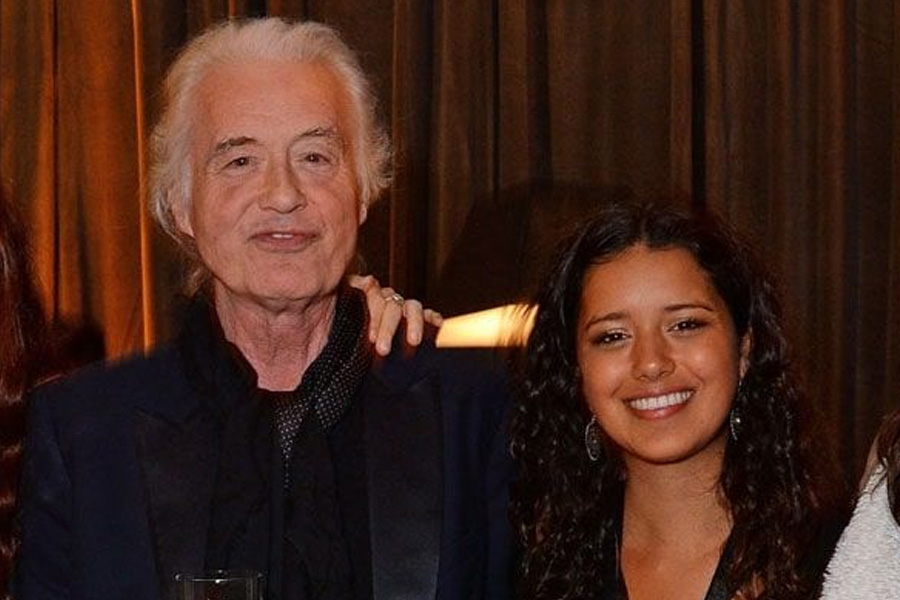
One of the most revealing things about Zofia Jade Page is that she shows up in public records not as a celebrity in full sprint, but as part of a family moment. That is telling. There is a difference between being photographed and being public in the modern sense. A photograph can be a trace, a footprint in wet sand. It tells us someone was there, but it does not tell us how they wanted to be seen.
That kind of appearance gives Zofia a different kind of visibility. She is not a nonstop media presence, but she is not entirely invisible either. Her public profile is stitched together from family event coverage, social traces, and occasional references that seem to drift in from the broader story of Jimmy Page’s life. The effect is almost archival. You find her name the way you find an old note tucked into a book.
I find that more interesting than a conventional celebrity biography. It raises better questions. What does it mean to have a public identity without a public career? How much of a person is constructed from the attention around them? And how much of that attention is simply the echo of someone else’s louder life?
The contrast between artistic lineage and personal obscurity
The Page family carries a strong artistic afterimage. That is unavoidable. Jimmy Page’s fame is not small, and Scarlet Page’s work in photography shows that the creative impulse did not stop with one generation. Scarlet’s public career offers one side of the family story: visible, structured, and professionally legible. Zofia offers another side: less documented, less curated, and therefore more mysterious.
This contrast is useful because it keeps the family from flattening into a single narrative. Not every child of a famous parent follows the same route. Some pursue art directly. Some find work behind the scenes. Some choose privacy and let the family name do the talking. Zofia seems to sit somewhere in that third space, where identity is real but not overexplained.
I think that is a modern kind of power. We often assume influence only counts when it is posted, branded, or monetized. But there is also influence in restraint. A person can refuse the obvious path and still leave an impression. In Zofia’s case, the impression is of someone who has not handed her life over to the public machine.
Charity, legacy, and the wider circle around her upbringing
The family story also opens into another dimension: charity and social responsibility. Jimena Gómez-Paratcha’s connection to children’s work in Brazil, and Jimmy Page’s association with that sphere, give the family background a humanitarian thread. That matters because it suggests the Page family story is not only one of music, fame, and private relationships. It also includes public-minded work and concern for children and community.
That kind of backdrop changes the tone of the biography. It makes the family feel less like a dynasty that floats above ordinary life and more like a household with obligations, ideals, and complications. For Zofia, that means her upbringing was likely shaped not just by celebrity culture but by a broader moral and social environment. Even if she has not built a public career around those themes, the influence of such a setting can linger like scent in fabric.
I also think it helps explain why so little about her life feels aggressively performative. A family culture that includes private values, artistic work, and public responsibility can produce people who do not feel compelled to broadcast every move. Privacy can be inherited too, or at least normalized.
Social presence and the modern art of controlled visibility
In the social media age, silence has become a kind of signal. When someone with a famous last name posts sparingly, the gaps speak almost as loudly as the images. Zofia Jade Page appears to use that kind of controlled visibility. Not absent, not overexposed, just carefully placed. A trace here. A moment there. Enough to confirm presence, not enough to invite ownership.
I find that approach elegant. It resists the constant demand to explain oneself. It treats the self less like a product and more like a studio with the door partly closed. The public can stand at the threshold, but not every room is open for inspection.
That posture also helps explain why the internet tends to fill in the blanks with guesses. In the absence of a full career profile or official biography, fan pages and entertainment writeups often do the work of imagining one. But imagination is not documentation. Zofia’s public image is interesting partly because it leaves so much unsaid. The silence is not empty. It is structured.
Why Zofia Jade Page remains a compelling figure
I keep coming back to the same idea: Zofia Jade Page is compelling because she occupies a narrow bridge between fame and privacy. On one side is the enormous shadow of a legendary father. On the other is the possibility of a life that does not need to perform for mass consumption. Very few people live comfortably on that bridge. Most are pulled toward one side or the other.
Her story also reminds me that public identity is not always built from achievement alone. Sometimes it is built from context, family, and selective visibility. Sometimes a person becomes interesting because they refuse the standard script. That refusal can be quiet, almost invisible, but it still reshapes the narrative.
If the public story of the Page family is a long record, Zofia’s track is the soft one that rewards careful listening. It does not demand applause. It asks for attention of a different kind. In a noisy era, that feels rare.
FAQ
Who is Zofia Jade Page?
Zofia Jade Page is the daughter of Jimmy Page and Jimena Gómez-Paratcha. She is known publicly mainly through her family connections and occasional appearances rather than through a major public career.
What makes Zofia Jade Page different from other celebrity children?
What sets her apart is her low-profile presence. She does not appear to pursue constant publicity, and that gives her a quieter, more private public identity than many people connected to famous families.
Does Zofia Jade Page have siblings?
Yes. Her family includes Jana, who is often described as an adopted older sibling, Ashen Josan Page as a younger sibling, and half-siblings including Scarlet Page and James Patrick Page Jr.
Has Zofia Jade Page been seen at public events?
Yes. She has appeared in family-related public coverage, including a notable book launch connected to the Led Zeppelin legacy, where members of the Page family were photographed together.
Is there a verified career profile for Zofia Jade Page?
There is no widely documented mainstream career profile for her. Public mentions focus more on her family background and occasional appearances than on a large professional body of work.
What is known about her online presence?
She appears to maintain a limited and selective public presence. That suggests a preference for privacy and controlled visibility rather than a heavily managed public brand.
Is there a reliable net worth estimate for Zofia Jade Page?
No reliable personal net worth estimate is publicly verified. Most numbers that circulate online are speculative and should be treated cautiously.
How does the wider Page family shape Zofia Jade Page’s public image?
The family’s mix of fame, creativity, privacy, and public-facing work shapes how Zofia is perceived. She is part of a lineage with strong cultural weight, yet she seems to keep her own life deliberately less exposed.


